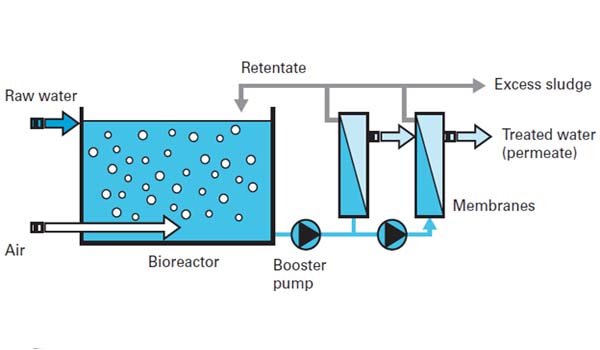
Membrane Bio Reactor (MBR), is the combination of activated sludge treatment together with a separation of the biological sludge by micro- or ultrafiltration membranes with pore size of typically 10 nm to 0.5μm to produce the particle- free effluent. The physical barrier imposed by the membrane system provides complete disinfection of the treated effluent. It also enables operation at higher sludge concentrations (typically up to 20 g/L instead of max. 6 g/L with conventional systems), and therefore permits to reduce the required footprint of system.
The water with required MLSS enters the MBR tank after aeration. The MBR facility consists of aerobic tank (MBR Tank) and anoxic tank. MBR tank consists of MBR membrane modules mounted on structural frame along with the back pulse tank arrangement on the top. Air diffusers are provided below the membrane modules for air scouring.
Membrane modules are immersed inside the aerobic tank where organic contents (BOD) in the sewage will be biologically degraded by activated sludge. The MLSS (Mixed Liquor Suspended Solids) concentration in the MBR System is 10 to 20 g/L compared to 3 to 4 g/L in conventional activated sludge systems, thus the retention time required is only 30% of conventional system thus reducing the reactor volume to achieve the same loading rate.
The membranes also separate suspended solids from liquid through the filtration process. As the pore size of the membrane is 0.01 micron, not only suspended solids but also bacteria such as coliform bacteria are also removed. Through recirculation of MLSS from aerobic tank to anoxic tank, nitrate content is removed. Additional coagulant and flocculant dosing also can be incorporated for phosphorous removal (optional).